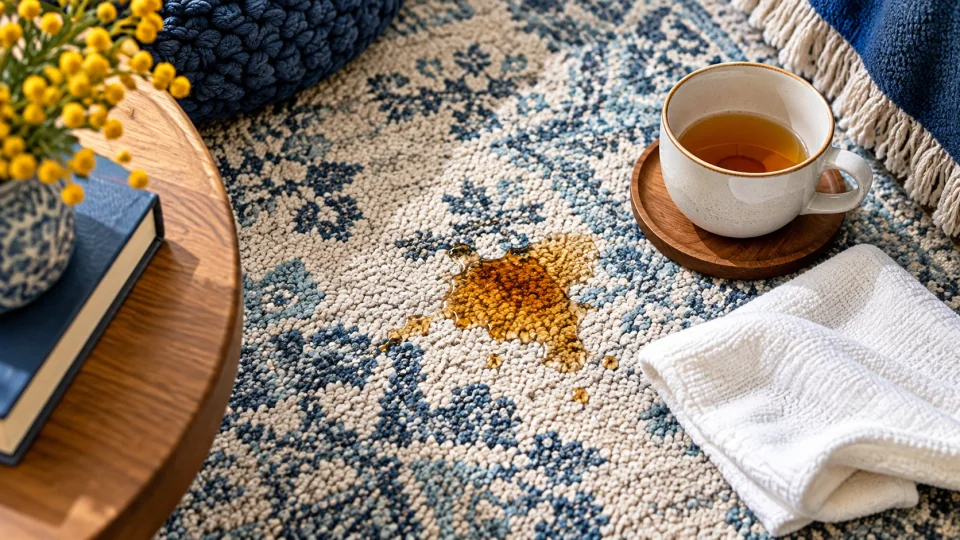
Use the chart to choose a cautious first response, not as a chemical recipe. The instructions for the actual carpet and cleaner control what can safely be applied. This page sets out six first decisions and their stop points, followed by an observation-and-question record with six hypothetical examples, so that when you do ask for help you can say exactly what you saw.
Before applying anything
CRI and Shaw advise prompt blotting rather than rubbing. CRI also advises pretesting an appropriate cleaner and following its directions.
Do not assume water, dish liquid or a solvent is suitable for every rug. Wool, silk, valuable rugs and unidentified materials need more specific guidance.
Observe first, then decide
Note what you can without delaying an appropriate first response. For an ordinary liquid spill on an identified carpet, follow the prompt-blotting guidance below; for a hygiene issue or an uncertain material, follow the relevant stop and advice points. Record what you saw and did as soon as practical. A precise description can help a maker, supplier or professional understand the question better than 'there is a stain on the carpet'.
The sections that follow assume the carpet is something you can identify. If you cannot say what the material is, or if it is wool, silk or a valuable rug, the first decision is to seek specific guidance rather than choose from the chart.
- What was spilled, if known, and how sure you are about it.
- Where it happened and how large the affected area looks.
- What the carpet or rug is, according to a label, document or maker, and whether you have its care instructions.
- What has already been done: blotted, anything applied, anything walked through it.
- Anything that changes while you watch: colour appearing on the cloth, the mark spreading, a change in texture.
- Anything you are unsure of, which becomes a question.
First decisions by spill type
Each entry gives an initial decision and the point at which to ask for help.
- Coffee, tea, wine or juice: blot free liquid with a clean, white absorbent cloth and check the carpet maker's instructions before treating the remaining mark. If colour transfers or the mark spreads, stop.
- Pet urine: blot promptly and select only a product specifically approved for the carpet and the problem. Persistent odour or affected backing needs an appropriate assessment; surface cleaning cannot be assumed to reach it.
- Blood, vomit or feces: treat these as a hygiene issue, not just a cosmetic stain. Avoid contact and follow appropriate public-health and product instructions. Where contamination, illness or safe handling is uncertain, use an appropriate professional.
- Grease, makeup, ink or marker: do not start a sequence of powders or solvents based on the stain name alone. Use the specific manufacturer instructions or ask a specialist.
- Gum or wax: avoid heating the carpet or forcing hardened material out of the pile. Get a method suitable for the fibre and backing before proceeding.
- Mud or an unidentified white residue: identify the residue where possible and follow the maker's care guide. A persistent mark is not proof of its chemical cause.
Why the stop points sit where they do
The chart deliberately gives few instructions and several stop points. For drinks, the only action before checking the maker's instructions is blotting; colour transfer or spreading is the signal to stop, and the page does not try to say what is happening or how to fix it. For pet urine, the emphasis is on approval for both the carpet and the problem, and on the limit of surface cleaning: odour that persists, or backing that has been reached, is a case for assessment rather than another attempt.
Blood, vomit and feces are described as a hygiene issue rather than a cosmetic one. That changes the question from 'what removes it' to 'how can it be handled safely', which is why the entry points to public-health and product instructions and to a professional where handling is uncertain. This page offers no medical diagnosis and no statement about organisms.
For grease, makeup, ink and marker, the chart warns against building a sequence of powders or solvents from the stain's name alone, because the name does not tell you what the carpet can tolerate. For gum and wax, the caution is against heating the carpet or forcing hardened material out of the pile; the method has to suit both the fibre and the backing. For mud and white residue, the lesson is that a persistent mark does not reveal its own cause, so identification and the maker's care guide come first.
Products and moisture
Follow product quantities, rinsing and drying directions; this page does not specify a universal detergent dilution.
CDC advises against mixing cleaning products or chemicals. A hard-surface disinfectant is not automatically suitable for porous carpet or upholstery. For the broader difference between cleaning and disinfecting, there is a separate guide: cleaning versus disinfecting carpets, rugs and upholstery.
Stop if the textile changes colour or texture.
The observation-and-question record
Copy the fields below onto a sheet or into a note on a phone. They are a suggestion for organising what you know; complete them when practical, without delaying the appropriate first response. The last three fields are the important ones, because they turn the situation into specific questions.
- Date and place: when it happened and where on the carpet or rug.
- Material: what the maker or label says, or 'unknown'. Wool, silk, valuable rug or unidentified: mark it, because these need more specific guidance.
- What it appears to be and how sure you are.
- Already done: blotting, anything applied, anything walked through it.
- Observations: colour transfer, spreading, change in texture, odour that persists.
- Chart entry that applies, and whether a stop point has been reached.
- Products considered: record both the carpet maker's permission for the proposed use and the actual product's directions. Note anything missing or conflicting before considering further treatment.
- Question to ask, and of whom: maker, product maker, supplier or an appropriate professional.
- Next step, which may simply be 'wait for an answer'.
Six synthetic records
The records below are invented for illustration. They do not describe real incidents, they are not measured outcomes, and none predicts whether a mark would come out. In each, the actual carpet and product instructions control.
Synthetic record 1, tea on a light fitted carpet. Observed: free liquid blotted with a clean white cloth; colour is visible on the cloth and its source has not been established; the mark has not spread. Material: the maker's care document has not yet been found. Chart entry: coffee, tea, wine or juice; further treatment is paused because the colour transfer is unexplained. Question: could carpet colour be transferring, and does the maker's guidance name a permitted cleaner and its pretest? Next step: locate the document and ask for advice before treating the remaining mark.
Synthetic record 2, a pet accident on a bedroom carpet, noticed some time after it happened. Observed: blotted; a smell remains. Chart entry: pet urine; the persistent odour reaches the stop point. Question: who can assess whether the backing has been affected, and which product, if any, is specifically approved for this carpet and this problem? Next step: ask for an assessment rather than repeating surface cleaning.
Synthetic record 3, vomit on a hallway carpet; someone in the household had been unwell. The record notes that fact only; it makes no assumption about cause and offers no diagnosis. Chart entry: blood, vomit or feces; treated as a hygiene issue. Question: what do the appropriate public-health and product instructions say about safe handling, and is a professional needed given the uncertainty? Next step: avoid contact and seek those instructions before cleaning.
Synthetic record 4, marker on a rug of unknown material. Observed: the mark is small; the rug has no label. Chart entry: grease, makeup, ink or marker; the unknown material also triggers the wool, silk and unidentified-materials caution. Question: how can the rug's material be identified, and what does the maker or a specialist advise? Next step: do not begin a sequence of powders or solvents.
Synthetic record 5, gum pressed into carpet near a doorway. Observed: hardened, sitting in the pile. Chart entry: gum or wax; no heating and no forcing hardened material out. Question: what method suits this fibre and backing? Next step: obtain that method before proceeding.
Synthetic record 6, a white mark near the entrance after wet weather. Observed: unclear whether it is mud residue or something else. Chart entry: mud or unidentified white residue. Question: can the residue be identified, and what does the maker's care guide say? Next step: follow that guide; treat the persistence of the mark as unexplained rather than as evidence of any particular cause.
Who to ask, and what to bring
The record points to four possible sources of an answer. The carpet maker can say what its instructions permit. The maker of a cleaning product can say what its directions allow. Ask the supplier whether the material can be identified. For persistent pet-related odour or affected backing, seek the appropriate assessment described in the chart. For unidentified material, ask what specialist guidance is needed; this guide does not establish anyone's ability to identify it. Which one is relevant depends on the entry; for example, the unknown rug in record 4 is a specialist question, while the tea mark in record 1 is a question for the carpet maker's guidance.
Bring your notes and photographs. If you are weighing whether to hire help, choosing a carpet or upholstery cleaner covers that broader decision. None of these guides certifies a product, a business or a stain-removal result.
Other materials
For furniture, see upholstery care; for mattresses, see the mattress and bedding guide; for rugs, see the Oakville rug-planning guide. The chart is written for carpet and is not a substitute for the instructions for upholstery, bedding or a particular rug.
Questions about this guide
Why does the chart not give a cleaning recipe for each spill?
Because what can safely be applied depends on the actual carpet and the actual cleaner. The chart gives a cautious first decision and a stop point, and the page does not specify a universal detergent dilution. Follow the product's quantities, rinsing and drying directions and the carpet maker's instructions.
Should I rub a spill to get it out?
CRI and Shaw advise prompt blotting rather than rubbing. CRI also advises pretesting an appropriate cleaner and following its directions. For colour transfer, spreading or a change in the textile's colour or texture, the chart says to stop.
Can I use a disinfectant on a carpet spill?
Not automatically. A hard-surface disinfectant is not automatically suitable for porous carpet or upholstery, and CDC advises against mixing cleaning products or chemicals. For blood, vomit or feces, the chart treats the spill as a hygiene issue: avoid contact, follow appropriate public-health and product instructions, and use a professional where contamination, illness or safe handling is uncertain. This page makes no claim about organisms or about medical matters.
What should I do if a mark remains or an odour persists?
For persistent pet-related odour or affected backing, seek an appropriate assessment; surface cleaning cannot be assumed to reach the problem. For another remaining mark, check the carpet maker's instructions before further treatment and ask if they do not cover it. Use your observation record to describe what happened and what has already been done.
Sources
Historical topic sources
Archived pages explain the origin of these topics; they are not evidence of current services or health outcomes.