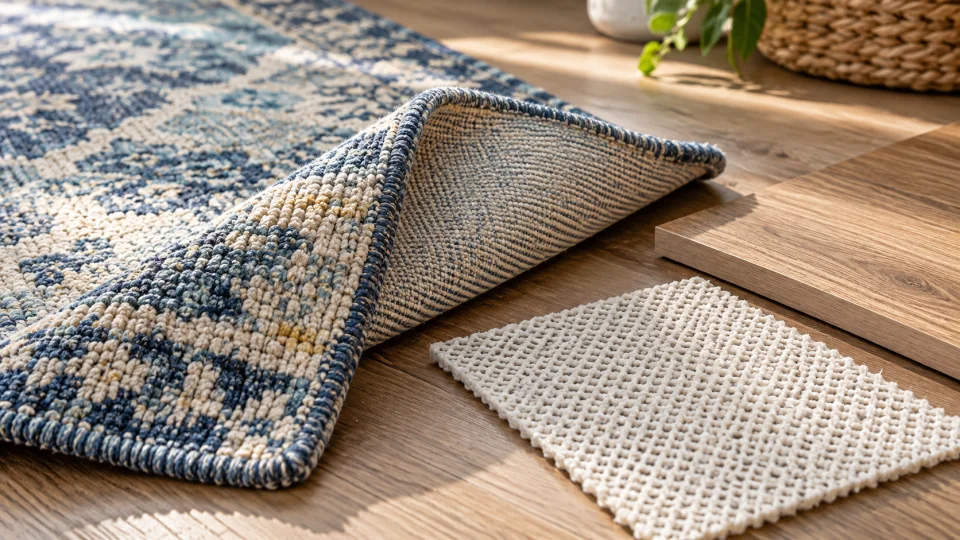
If you are caring for an area rug in Oakville, start with its construction and care label. The town name does not establish the fibre, value or cleaning needs of a rug, and this guide does not assume a particular type of home. It offers a worksheet for recording what you know about a rug, a second worksheet for checking a pad against the floor beneath it, and a hypothetical example of deciding to ask a specialist.
Identify what you have
Keep the label or the supplier's instructions. Record any previous treatment and describe the spill before asking for advice.
For a wool or wool-blend rug, look for a method and product explicitly suitable for it. WoolSafe's testing explains why cleaner chemistry and correct dilution matter; a general household cleaner is not automatically suitable.
Identification comes before any decision about cleaning because the right method depends on the material. Two rugs that look similar can differ in fibre, construction and dye, and a wrong guess can turn a small problem into a larger one. If you cannot say what the rug is made of, the honest entry in your notes is 'unknown', and that is a perfectly good reason to ask for help.
A rug identity and history worksheet
The worksheet below is a suggestion for gathering information before you ask anyone for advice. It is not a standard. Record only what you actually know, and write 'unknown' for anything you do not. Do not fill gaps with assumptions based on where you live or how the rug looks.
- Label or supplier instructions: keep the label, a note of what it says, or the supplier's care instructions. If the label is missing, note when it was lost or whether one ever existed.
- Fibre, as stated: record the fibre only as it is stated on the label or by the supplier, including any blend. If it is not stated, write 'unknown'.
- Construction, as stated: note whether the supplier described the rug as handmade or machine-made, and anything stated about its backing. Again, record only what was said.
- Origin and age: note what you know about where the rug came from, such as a purchase, a gift or an inheritance, and whether you know its age. Do not estimate value yourself.
- Previous treatment: record any earlier cleaning, repair or protector treatment, who did it and what was used if you know.
- Current problem: describe the spill or mark in plain terms, including when it happened, what was spilled if known and what has already been done to it.
- Colour behaviour: note any sign that colours may be unstable, such as colour that has marked something else before, without testing it yourself.
- Where it lies: record the room, the floor finish beneath it and whether it sits under furniture or in a doorway.
- Pad or backing: note what is under the rug, if anything, and any product name.
- Questions for a specialist: list what you want to ask, so the conversation covers it.
Wool and wool-blend rugs
If your worksheet says wool or a wool blend, the practical point from WoolSafe's testing material is that the cleaner's chemistry and its correct dilution matter, and that a general household cleaner is not automatically suitable. Look for a method and product explicitly intended for the material, and follow the product's own label and the rug maker's directions.
This guide does not recommend a particular product, strength or method, and it makes no claim about how any product will perform on your rug. If the instructions do not clearly cover your situation, treat that as a signal to stop and ask, not to improvise a stronger mix.
Valuable or uncertain rugs
If the rug is handmade, antique, has unstable colour or cannot be identified, ask an appropriate rug specialist before applying liquid or chemicals. CRI advises following the rug manufacturer's directions and obtaining professional care for heirloom pieces.
A quick damp-cloth test alone does not prove an entire wash will be safe.
A small test looks at one spot, at one moment, with one liquid. It cannot show what happens when the whole rug is wetted, agitated and left to dry, nor how the backing or other colours will behave. It is therefore not a safe-wash certificate, and this guide does not recommend carrying one out on a rug whose value or construction is uncertain. If the worksheet is mostly 'unknown', that is already a reason to ask a specialist before doing anything at all.
A hypothetical decision: should I ask a specialist?
This example is invented for illustration. It does not describe a real household, and it makes no claim about the value, fibre or construction of rugs in Oakville or anywhere else.
Imagine someone who has been given a rug by a relative. It has no label, the relative cannot remember where it came from, and a drink has been spilled on one corner. The owner's first instinct might be to dab it with a general household cleaner, or to test a corner with a damp cloth and, if nothing seems to happen, wash the whole rug.
Using the worksheet, the owner writes down what is known: no label, origin unknown, fibre unknown, construction unknown, previous treatment unknown, the drink as the current problem, and the floor beneath it. Nearly every field says 'unknown'. Against the CRI advice to follow the manufacturer's directions and obtain professional care for heirloom pieces, and against the WoolSafe point that chemistry and dilution matter, the owner decides not to apply liquid or chemicals and to ask an appropriate rug specialist first.
The owner then sends the specialist the completed worksheet and a description of the spill, and asks what they would need to see, how they would identify the material, what they advise in the meantime and what the options might be. In this invented case the decision to ask is a precaution, not a finding that the rug is valuable. The specialist might judge it ordinary or might not, and the case does not predict which.
A pad and floor compatibility worksheet
Ask the rug and floor suppliers whether a proposed pad or backing is compatible with the actual floor finish. Do not assume every non-slip pad prevents staining.
The worksheet below is a suggestion for keeping the answers together. A pad is a product with its own materials and its own instructions, and nothing in this guide promises that any pad protects a rug or a floor from marks.
- Floor finish: write down the finish as identified by whoever supplied or installed the floor. If you do not know, ask them and record 'unknown' until they answer.
- Pad: note the product name and the supplier's description of what it is made of and what it is intended for.
- Rug backing: note what the rug's backing is, as stated by the rug supplier.
- Compatibility statements: ask the pad supplier, the rug supplier and the floor supplier whether they consider this combination suitable, and keep each answer, preferably in writing.
- Disagreement: if the suppliers give different answers, do not choose between them by guesswork. Ask each to respond to the other's point or ask a specialist.
- Staining: do not treat a pad as a promise that a rug will not stain; ask what, if anything, the supplier actually states about staining.
- Dryness: before putting the rug back, make sure the rug and the surface underneath are dry.
- Instructions: keep the supplier's directions for use and storage alongside the worksheet.
Floor and storage planning
Put a rug back only after it and the surface underneath are dry, and follow the supplier's storage directions.
Storage and return are the last steps in a care plan, and they are easy to skip. A rug that is put back before it is dry, or stored in a way the supplier does not recommend, can undo careful earlier work. Note the storage directions on the worksheet when you first record the label, so that you have them when you need them, and keep them with any pad information.
Related guides
See the carpet spot and stain chart for initial spill decisions, caring for upholstered furniture for reading care labels, the stain protection guide before any protector treatment, and choosing a carpet or upholstery cleaner for questions to ask a specialist.
Questions about this guide
What should I record if I cannot identify my rug?
Keep any label or supplier instructions, describe the spill and record previous treatments you know about. Write 'unknown' for fibre, construction or history you cannot confirm. If the rug cannot be identified, ask an appropriate rug specialist before applying liquid or chemicals; its location does not establish its material or value.
Is a damp-cloth test enough to show a rug can be washed?
No. A quick damp-cloth test alone does not prove an entire wash will be safe. It examines one spot at one moment and cannot show how the whole rug, its backing or its other colours will behave. If the rug is handmade, antique, has unstable colour or cannot be identified, ask an appropriate rug specialist before applying liquid or chemicals.
Can I use a general household cleaner on a wool or wool-blend rug?
Not automatically. Look for a method and product explicitly suitable for wool or wool blends. WoolSafe's testing explains why cleaner chemistry and correct dilution matter, and a general household cleaner is not automatically suitable. Follow the product label and the rug maker's directions, and ask a specialist if they do not cover your case.
Will a non-slip pad stop a rug from staining the floor, or the rug from staining?
Do not assume so. Do not assume every non-slip pad prevents staining. Ask the rug and floor suppliers whether the proposed pad or backing is compatible with the actual floor finish, and keep their answers. Put the rug back only after it and the surface underneath are dry, and follow the supplier's storage directions.
Sources
Historical topic sources
Archived pages explain the origin of these topics; they are not evidence of current services or health outcomes.