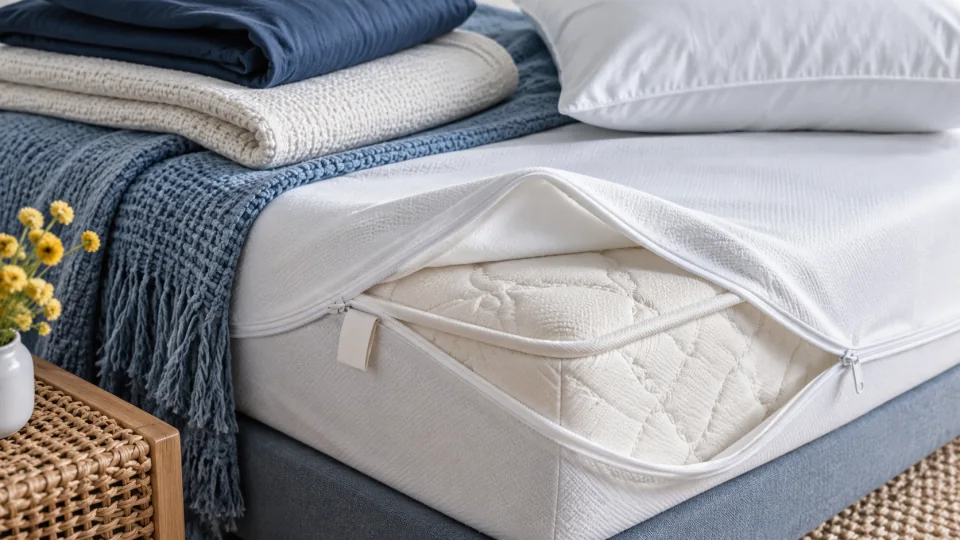
A mattress and its cover can require different care from sheets; follow the manufacturer’s label for the actual item. This guide combines public-health advice on dust mites with practical checks, without claiming that any method makes a bed allergen-free or sterile. It adds a label-led decision pathway and a list of questions to settle before any work begins, whether you do the work yourself or hire someone.
Start with the label and warranty
Find the mattress manufacturer's care label and any warranty document before applying liquid, foam or a cleaning product. Check what they say about permitted cleaning methods, stains and covers.
A removable cover is not necessarily washable, and a method suitable for one mattress is not automatically suitable for another. If the instructions are missing or unclear, ask the manufacturer or supplier.
The label comes first because everything else on this page depends on it. A care label may be sewn into a seam or printed on a tag, and warranty paperwork may add conditions about stains, liquids or covers. If you cannot find either, a photograph of the visible tags showing the brand and model details makes it easier to ask the manufacturer or supplier what is permitted. As a suggestion, keep any reply with the warranty papers so you can show later what you were told.
A label-led decision pathway
The pathway below is a suggested order of decisions, not a cleaning protocol. It deliberately contains no temperatures, chemical choices or contact times, because those belong to the manufacturer's label and the product's own instructions. Its purpose is to stop work before it starts whenever something important is unknown.
Where the pathway ends in 'ask', that is a legitimate outcome rather than a failure. A method suitable for one mattress is not automatically suitable for another, so asking first is a sound result when the label is silent.
- Identify each item separately: the mattress itself, any removable cover, any allergen-proof cover, the pillows, and the sheets and other bedding. Each may have its own care label.
- Find the care label and any warranty document for each item that has one. If an item has none, record 'no label found'.
- Read what each label permits: cleaning methods, anything about stains, liquids and covers, and washing and drying directions. Do not assume a removable cover is washable.
- If the instructions are missing, unclear or conflicting, stop and ask the manufacturer or supplier before applying liquid, foam or any cleaning product.
- Decide which kind of task you have. Routine dust care with a suitable vacuum attachment and setting is one task. Laundering covers, pillows and bedding by their own labels is another. Treating a mark or spill is a third. Water damage or mould is a fourth, and it calls for advice.
- For a mark or spill, follow the label's direction on how much liquid, if any, may be used. If the label does not say, ask before wetting the surface.
- For a soaked mattress, a large spill or signs of mould, ask the manufacturer or a qualified professional before deciding how to proceed. For blood, vomit, urine or feces, avoid contact, follow appropriate public-health and product instructions, and use an appropriate professional where contamination or safe handling is uncertain.
- Before using any product, check that it is suitable for a porous surface, read its label, provide ventilation and never mix products.
- Write down what you did and what you were told, in case a warranty question arises later.
Covers and bedding routines
For dust-mite control, CDC recommends allergen-proof mattress and pillow covers, washing bedding weekly and drying it completely.
Follow the care instructions for the covers, pillows and bedding themselves, including their washing and drying directions.
If someone has allergy or asthma symptoms, ask a qualified clinician which measures suit their own triggers. Bedding care is part of a wider plan, not a treatment.
A bed has several layers with different care instructions. Keep them separate instead of applying one item's directions to another:
- Mattress: the manufacturer's label and warranty govern permitted cleaning methods and any liquids.
- Allergen-proof mattress and pillow covers, which CDC recommends for dust-mite control: follow each cover's own washing and drying instructions. Whether a cover suits your particular mattress is a question for the cover's and the mattress's documentation.
- Pillows: their own care instructions, which may differ from those for the mattress or the sheets.
- Sheets and other bedding: CDC's advice is weekly washing and complete drying, following the washing and drying directions on each item's label.
'Wash weekly and dry completely' is CDC's advice for bedding. It is not a statement about mattresses, and it does not turn into a temperature recommendation here. The label for each item gives that direction.
Vacuuming and dust
EPA recommends regular vacuuming, and a HEPA-equipped vacuum can help retain captured dust. Use an attachment and setting suitable for the mattress surface and follow the vacuum manufacturer's instructions.
A person with asthma or allergies should stay away from the room while vacuuming stirs dust into the air.
Mattress surfaces differ: seams, piping and quilted tops are not the same as a flat panel, and the vacuum manufacturer's instructions say which attachment and setting suit which surface. If you are unsure whether an attachment is suitable for the mattress surface, ask the mattress manufacturer before proceeding. It is also worth reading the vacuum's own manual for what it says about its filtration, rather than relying on advertising.
This guide does not specify a waiting period after vacuuming or a recommended frequency. As a practical suggestion, plan the task for a time when the person with asthma or allergies can be elsewhere in the home, and when the room can be left.
Moisture and spills
Avoid over-wetting a mattress. Liquid applied to the surface may not stay at the surface, so follow the label's directions on how much liquid, if any, may be used.
If a mattress has been soaked by a leak or a large spill, or shows signs of mould, ask the manufacturer or a qualified professional before deciding how to proceed. EPA's 24–48 hour guidance is a mould-prevention objective for drying wet materials after water damage, not a promise that a particular item can be saved.
Blood, vomit, urine or feces are a hygiene issue as well as a stain. Avoid contact, follow appropriate public-health and product instructions, and use an appropriate professional where contamination or safe handling is uncertain.
This is the reason for the label-first approach. If liquid can travel below the surface, then a mattress that feels dry on top may not tell you the whole story, and this guide does not offer a way to check. The label's liquid directions and the manufacturer's answers are the safeguards.
Three hypothetical illustrations, not measured cases. First, a small drink spill on a mattress with a cover: the pathway sends you to the cover's care label and the mattress label's directions on liquid. Second, a leak that soaks a mattress: the pathway sends you to the manufacturer or a qualified professional, and EPA's 24–48 hour objective is context for why not to leave it, not a promise of a result. Third, a child's accident involving bodily fluids: avoid contact, follow appropriate public-health and product instructions, and use a professional if safe handling is uncertain.
Cleaning products
CDC advises using products suitable for the surface, following label instructions, providing ventilation and not mixing cleaning products or chemicals. A hard-surface disinfectant is not automatically suitable for a porous mattress, pillow or upholstered surface.
Words such as natural, green or anti-allergen on a label do not replace those checks.
One way to hold the checks together is as three questions. Is this product made for this kind of surface? What does its own label tell me to do? What does the mattress or cover label allow? If any answer is unknown, the pathway ends in 'ask'. The cleaning versus disinfecting guide explains why a label written for hard surfaces does not carry over to soft ones.
Questions for a professional mattress cleaner
Ask for the answers in writing before the work begins.
Written answers matter because they give you something to compare with the manufacturer's label and to keep with the warranty papers. A reluctance to put answers in writing is itself information. For wider questions about choosing someone, see the guide to choosing a cleaner.
- Which method and products are proposed, and do they match the manufacturer's label for this mattress?
- How much moisture will be used, and what drying and return-to-use instructions apply?
- Can you show the label and safety information for any treatment you plan to apply?
- What will be done if a mark does not respond, and how will existing marks be recorded?
Questions to settle before any work
These are suggested questions for you to answer yourself, whether the work is done at home or by a professional. They are adaptable prompts, not a standard.
- Do I have the mattress label and warranty, and have I read what they say about cleaning methods, stains and covers?
- Does the mattress have a removable cover, and do I know whether it is washable rather than assuming?
- Have I told whoever will do the work about any warranty conditions and any marks or damage already present?
- Will a person with asthma or allergies be in the room during vacuuming or treatment?
- Is the room ventilated, and do I know where the mattress will be while it is being treated or dries, according to the instructions I have?
- Do I know when the bed can be used again, according to the label and the instructions I was given?
- If something goes wrong, do I know whether to call the manufacturer, the supplier or the cleaner first?
What not to expect
Be cautious of any claim that a single visit sterilises a mattress, removes all dust mites or relieves symptoms. This guide does not support such claims.
The same label-first test applies to marketing words. Terms such as sterilised, allergen-free, natural, green or anti-allergen are claims you can ask a seller to explain in writing and compare with the manufacturer's label. This guide does not claim results for any method, and it offers no promise about symptoms.
Archived pages from an earlier version of this site, listed under sources, covered mattress cleaning and a related special, as their page names indicate. They are cited for historical subject scope only. This guide does not restore their offers, prices or claims, and nothing here is an active booking or service. The site is an independent editorial resource.
Questions about this guide
How often should bedding be washed, and how should it be dried?
For dust-mite control, CDC recommends allergen-proof mattress and pillow covers, washing bedding weekly and drying it completely. Follow the washing and drying directions on the care labels of the covers, pillows and bedding themselves. This guide gives no temperature, because none is supplied, and bedding care is part of a wider plan rather than a treatment. A qualified clinician can advise on measures for someone's own triggers.
Can I take the cover off my mattress and wash it?
Not necessarily. A removable cover is not automatically washable, and a method suitable for one mattress is not automatically suitable for another. Check the mattress manufacturer's care label and any warranty first, and follow the care instructions on the cover itself. If they are missing or unclear, ask the manufacturer or supplier before applying liquid or a cleaning product.
Can I use a hard-surface disinfectant on a mattress?
A hard-surface disinfectant is not automatically suitable for a porous mattress, pillow or upholstered surface. CDC advises using products suitable for the surface, following label instructions, providing ventilation and not mixing cleaning products or chemicals. Check the product label and the mattress label before using anything, and ask the manufacturer if the answer is unclear.
My mattress has been soaked. What should I do?
Ask the manufacturer or a qualified professional before deciding how to proceed, especially if there are signs of mould. EPA's 24–48 hour guidance is a mould-prevention objective for drying wet materials after water damage, not a promise that a particular item can be saved. If the cause involves blood, vomit, urine or feces, avoid contact, follow appropriate public-health and product instructions, and use an appropriate professional where safe handling is uncertain.
Sources
Historical topic sources
Archived pages explain the origin of these topics; they are not evidence of current services or health outcomes.